Air Conditioning Repair & Installation
Central air repair, refrigerant diagnostics and full system installation, from a single failed capacitor to a unit that was undersized for the house from day one.
Most central air failures come down to one of three systems: the refrigerant circuit, the electrical components, or airflow. A capacitor failure looks like a dead unit. A low refrigerant charge looks like a unit that runs constantly and never quite cools the house. A clogged filter or blocked return can mimic both. Diagnosing which one it actually is, rather than guessing, is most of what a service call is for.
What a diagnostic visit involves
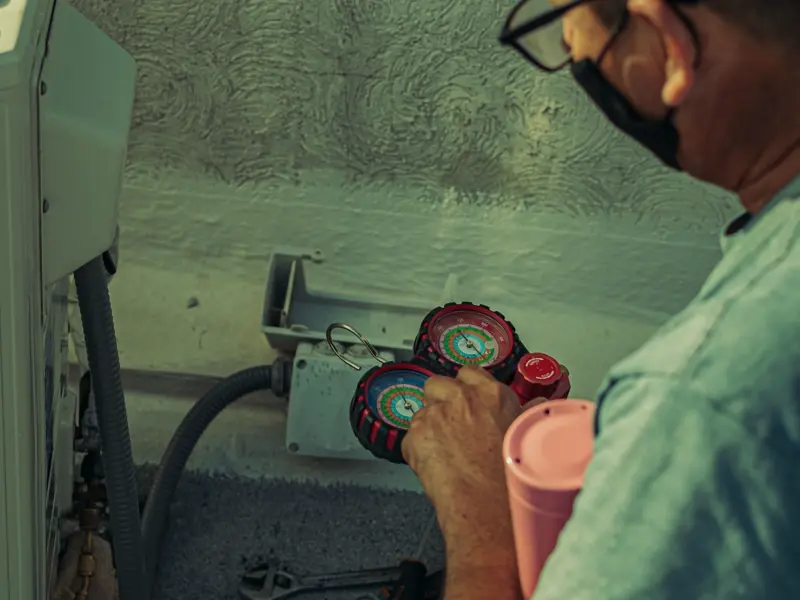
A technician checks the capacitor and contactor first, since those fail most often and are the fastest to rule in or out, then moves to refrigerant pressures with gauges connected to the service ports, and airflow across the coil last. Most cooling calls are diagnosed inside forty-five minutes. You get a plain explanation of the failed component and a written price before any repair starts.
On refrigerant leaks specifically, we look for the actual leak point with an electronic leak detector rather than simply topping off the charge and sending you a bill for refrigerant that will be gone again in a season. A system that is low on charge has a leak somewhere, and finding it is the only way to actually fix the problem instead of renting you the same visit again next summer.
When repair makes sense, and when it does not
A unit under ten years old with a failed capacitor, contactor or fan motor almost always gets a straightforward repair. Older systems on R-22 refrigerant, which has not been manufactured since 2020, are a different conversation: a major leak on an R-22 system usually costs more to recharge than a large share of a new system's price, and we will say so rather than quoting an expensive repair on a refrigerant that is only getting harder to source.
Installation, sized to the house
A replacement system gets a load calculation based on square footage, insulation, window exposure and duct condition, not a same-tonnage swap of whatever was there. An oversized system cools the air fast without running long enough to actually remove humidity, which is why an oversized AC can leave a house feeling clammy even at the right temperature. An undersized one runs constantly and still loses ground on the hottest afternoons. Both mistakes are common shortcuts on a fast install and both are avoidable.
Installation includes a nitrogen pressure test on all new refrigerant lines before charging, a vacuum to remove moisture from the line set, and a final charge weighed to the manufacturer's specification rather than eyeballed against a superheat chart. A startup report with measured pressures and temperatures is left with you at the end of the job.
Ductless and heat pump systems
For additions, garages, or houses without existing ductwork, we install and service ductless mini-split systems and heat pumps, which handle both heating and cooling from the same outdoor unit. These have become a common replacement for older baseboard electric heat in the county's older housing stock, since they cut electric heating bills substantially while adding air conditioning that the house never had.
Keeping a system out of trouble
Airflow problems, meaning a dirty filter or coil, are the single most preventable cause of a cooling failure and the easiest thing a maintenance visit catches before it becomes a no-cool call in July. Detail on that plan is on the maintenance plans page.
If your air conditioning stops working today
Check the outdoor breaker and the filter before calling; a tripped breaker and a clogged filter together account for a meaningful share of the calls we run. If the outdoor unit is running but no cold air is coming from the vents, turn the system off rather than letting it run, since a frozen coil needs time to thaw and running it continuously frozen can damage the compressor.